Last post, I ran out of steam after describing only two of the five species in my book: Homo naledi, or “treefolk” and Homo erectus, or “firstfolk”. This post, I’ll finish the series off with Homo longi or “dragonfolk”, more commonly known as Denisovans, Homo neanderthalensis or “tidefolk”, commonly known as Neanderthals, and Homo sapiens, or “kinfolk”.
Homo longi: “dragonfolk”
Other than H. sapiens, the dragonfolk play the largest role in my book. They’re also known from very little fossil material - just a handful of fragmentary bones, two half-mandibles, and two skulls, though more already-discovered material is being referred to the species all the time these days. It’s like finding jigsaw puzzle pieces: if all you have is middle pieces, you can’t place them anywhere relative to each other. But someone digs up some edge pieces, and bam, many previously-unidentifiable fragments fall into place. My dragonfolk are called that because the skull that was recently reidentified as Denisovan was known for a long time as “Dragon Man”, and the species epithet longi means “dragon”. In-universe, it’s not explained where the name comes from (but it likely comes from their close association with nonhuman animals, which is purely speculative).
Denisovans (named after the cave in which their remains were first definitively identified, which in turn is named after some guy called Denis) were large and robust people. The largest fossil woman known, the Jinniushan woman, stood five foot six and was likely a Denisovan or close relative. That may not seem giant, but back then H. sapiens women likely averaged under five feet due to malnutrition. Just imagine how tall Denisovans might’ve been if they had access to modern abundance!
The earliest high-altitude fossil known, the Xiahe mandible, is Denisovan, from 160 ka on the Tibetan plateau, over a hundred thousand years before H. sapiens made it to those heights. Modern Tibetans have a high-altitude-adapted gene that actually entered the gene pool through interbreeding with Denisovans, and multiple studies have found that around 5% of the genomes of modern Oceanians consist of Denosivan DNA. That’s a lot - essentially the equivalent of having a Denisovan great-great-great-grandparent. Other Asians and indigenous North and South Americans have only a little Denisovan DNA, around 0.1%, and Europeans and Africans have virtually none.
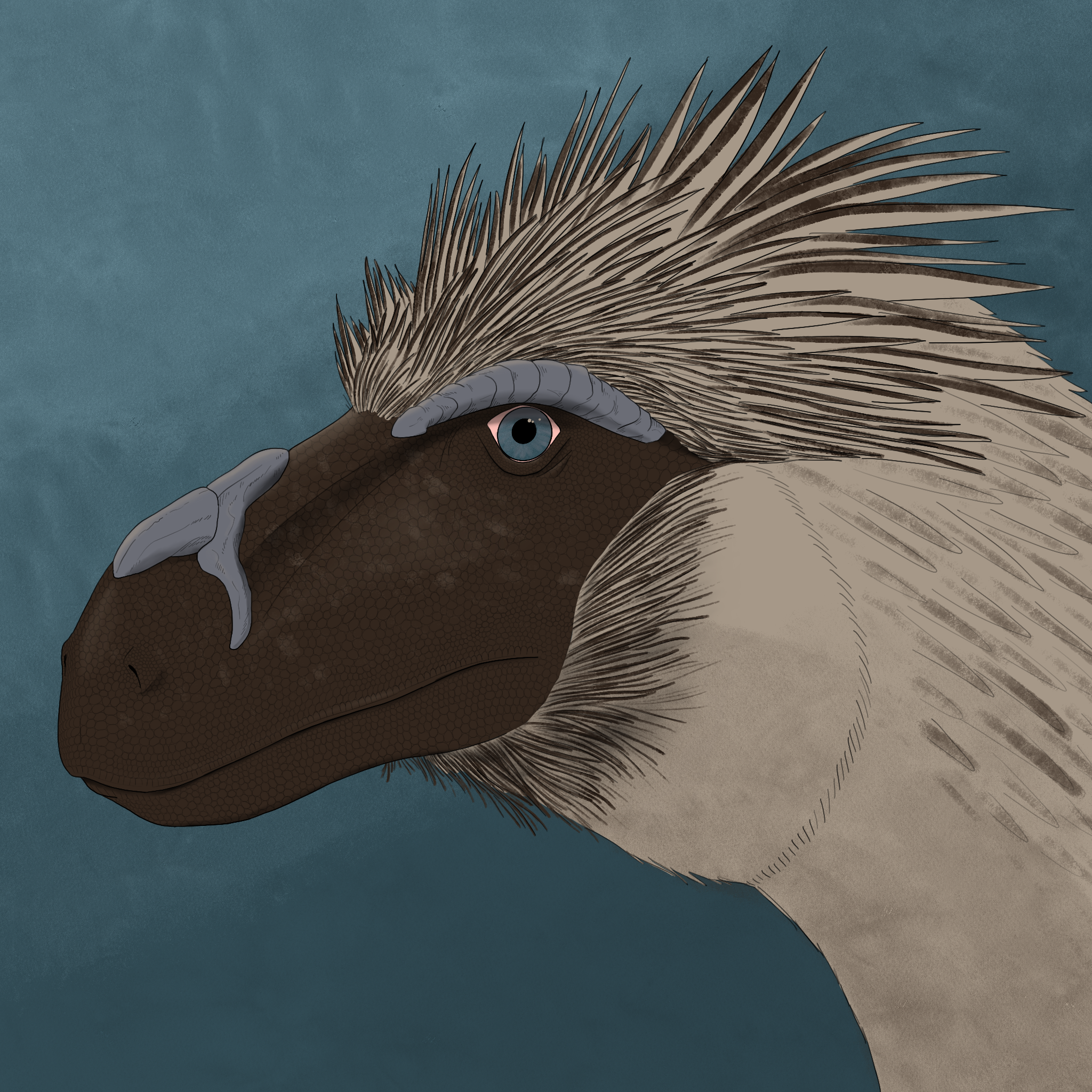
Since Denisovans were an Asian species, I depicted mine as looking vaguely Asian. Maybe something about that area of the world selects for eyes that tilt up at the corners and straight hair - who knows? But beyond the face, my Denisovans are quite different: they’re tall, dark-skinned, and have a lot of body hair. We know from DNA evidence that they were likely dark-skinned, but it also makes sense as an adaptation for UV resistance, important when you’re living at high altitudes. We don’t know whether or not they were woolly, but that also makes sense as a cold-weather adaptation and gives them yeti vibes, which is fun to imagine. In the past, there may actually have been elusive furry humanoids living in the Himalayas! They weren’t primitive ape-men, though, but rather were human enough that our ancestors interbred with them, and the subsequent hybrids were able to successfully find mates as well.
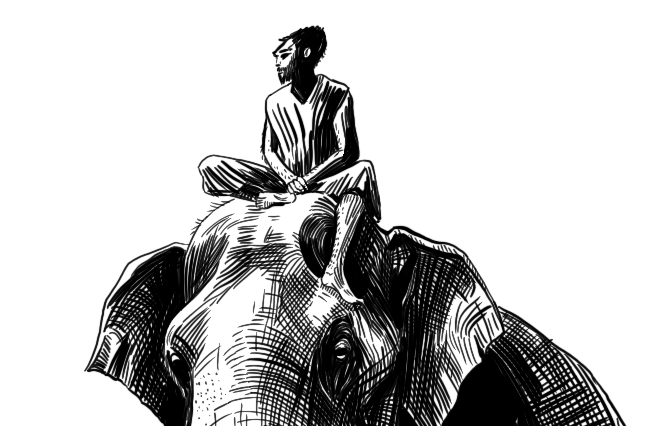
Denisovan braincases were long in the back rather than tall, so from the front they would’ve had small, sloping foreheads. The page image is a Denisovan man atop a Palaeoloxodon recki elephant, showing the unusual skull shape. Their brains were slightly larger than modern humans; due to that and their larger body size, my dragonfolk grow up slower and are longer-lived than H. sapiens. Denisovans had large brow bones in the shape of an “m” rather than H. erectus’s straight brow, but flat faces, similar to H. sapiens and distinct from the more prognathic Neanderthals and H. erectus. They had strong jaws but weak chins, though being woolly (in my head-canon at least) their chins would’ve been obscured by facial hair. All this together - the height, the body hair, the jawline, and the large brow - would’ve made dragonfolk quite manly and intimidating, and this affects how my hybrid kinfolk/dragonfolk protagonist is perceived. Among kinfolk (H. sapiens) she’s a masculine-looking girl and is therefore considered ugly, but among dragonfolk she’s hyper-feminine, and therefore beautiful.
I have a hypothesis about why Denisovan fossil material is so hard to find relative to that of H. sapiens and Neanderthals that also ties into where they’re from: maybe Denisovans practiced “sky burials”, or offering their dead to the vultures, the way Tibetans traditionally did. This type of funeral rite is practical in places with super-rocky or frozen soils, which would’ve described a lot of the places Denisovans lived: the Himalayas and the mammoth steppe. This cultural aspect doesn’t appear in the book, though. Maybe a sequel!
Other than a handful of wood, stone, and antler tools, that basically sums up everything we know about Denisovans as of right now. Since we know basically nothing about their culture, I did a lot of extrapolating. My dragonfolk are polygamous and live in smallish clans of five to eight breeding males, their harems, and their children, as well as a few yet-unpaired teenagers who transferred from other clans (to prevent inbreeding). This represents a larger group than Neanderthals are thought to have lived in, but smaller than H. sapiens: since group size is thought to inversely correlate with body size, as larger individuals require a larger territory to get enough calories to feed themselves, I thought it made sense for the stocky, muscular, cold-adapted Neanderthals to have the smallest groups and the taller, slenderer Denisovans to require maybe not quite as many calories. They are polygamous mostly just to contrast with H. sapiens’ monogamy and to give the plot’s love triangle an interesting twist.
A couple of purely speculative elements I gave my dragonfolk are being more commonly left-handed and always giving birth to twins. Given their football-shaped heads and larger bodies, I wonder if birth would’ve been somewhat less dangerous for them, and if they grew up slowly and possibly gestated for longer, squeezing more babies into one pregnancy might have made evolutionary sense. After all, we have two breasts! The left-handed thing was just for variety.
Finally, I gave my dragonfolk a close relationship with elephants, since, with bigger ears and skulls, they may have been able to hear the infrasonic rumbles elephants use to communicate, and with larger throats they may have been able to attempt to talk back. If you could hear elephant infrasound, I’m sure it would be extremely attention-grabbing, since it’s incredibly loud!
Homo neanderthalensis: “tidefolk”
The final extinct species that makes an appearance in my book are the Neanderthals, which I call “tidefolk” because their homeland is mostly around the Mediterranean. Actually, since the novel takes place in Ethiopia, only a single tidefolk appears, a wanderer who’s lived with a bunch of different species and speaks a bunch of languages. He has light-colored hair, skin, and eyes, which the other characters have never seen before, and which causes him chronic sunburn in the ruthless African heat, leaving him prematurely wrinkly; this is an adaptation to the cloudy, low-UV areas Neanderthals natively hail from. When hunting, he favors a large, heavy spear, which is something we have direct evidence for. Neanderthals likely hunted by bracing spears like this against the ground while their compatriots drove a large prey animal to impale itself on them. This hunting style is effective at killing the extremely large Ice Age megafauna, but it requires a huge amount of strength and is very dangerous. As a nod to that, my one tidefolk lost his family in a hunting accident years before the story begins. It’s estimated from the relative abundance of differently-aged fossils that 80% of Neanderthals who reached adulthood died before the age of forty.
Neanderthals had the biggest brains of any known hominin, significantly bigger than even modern H. sapiens and likely way bigger than the tiny, malnourished H. sapiens who lived back then. People vaguely blame “inferior brain organization” for the technological stagnation seen in the archaeological record of Neanderthal tools - in the Middle Palaeolithic, Neanderthals made long stone blades and hafted (wooden-handled) weapons that were far more advanced than anything H. sapiens could make at the time, but Neanderthals never advanced beyond this, while H. sapiens famously went on to invent the longbow and then the microchip. However, I (and Rebecca Wragg Sykes in her book Kindred: Neanderthal Life, Death, Love, and Art) think a much simpler factor is the real culprit: body size. An adult Neanderthal man in a cold climate required around 7500 calories per day, and therefore required a much larger territory to hunt in. If Neanderthals lived only with their immediate family and only came together in large groups once every few months, it would’ve been much harder to share ideas and make technological improvements at all, and whatever technological advances did happen would been more likely to have been lost to time. I think that given in the rest of the animal kingdom, a bigger brain within the same clade almost always results in a smarter animal regardless of body size (eg, a raven is smarter than a chickadee and an African grey parrot is smarter than a budgie), Neanderthal individuals would’ve been pretty bright. They just didn’t have a social structure that enabled the “technological ratchet”. Accordingly, my one tidefolk representative is a polyglot and a mentor-figure for the protagonist. Furthermore, my tidefolk are the only species to build musical instruments (the others have music but it’s just singing and clapping) and to make art (in charming dirty-old-man fashion, my tidefolk character sculpts busty figurines out of stone a la the Venus of Tan-Tan). Later Neanderthals made all kinds of art and self-decoration out of bird feathers, stones, bones, and pigments, but at the time my story is set, 240 ka, these art forms hadn’t been invented yet, by Neanderthals or H. sapiens or anyone else.
From fossilized Neanderthal ear bones, we can tell that their hearing range was optimized for picking out high-frequency consonants the same way ours is, and from their hyoid (throat) bones and rib cages, we think their voices may have been somewhat higher (due to a shorter vocal tract and flatter skull base) but possibly louder (due to a larger chest cavity) and more nasally (due to cavernous nasal passages that were likely an adaptation for humidifying freezing, dry air). In my novel, this is one reason the tidefolk are good instrumentalists: their singing voices aren’t very nice.
Unlike Denisovans, from whom we have very few tools and remains, we have direct evidence that Neanderthals were mostly right-handed: their right arm bones were routinely thicker than their left, and their teeth show wear characteristic of working hides with a scraper in the right hand (teeth were used as a third hand to pull the hide taut). This also doesn’t figure into the story, I just thought it was cool that we know that.
Homo sapiens: “kinfolk”
Just a couple very brief notes on the modern humans that appear in my book, since you likely know them intimately. My kinfolk live in large groups of sixty to eighty individuals who are monogamous and all sleep together in one giant tent. Being slenderer than tidefolk, they favor non-hafted wooden javelins that they throw at prey, since back then no one knew how to make stone tips that were delicate enough not to throw a projectile’s flight out of whack. This strategy doesn’t let these archaic kinfolk bring down as large of prey as tidefolk can, but it allows them to stay further away and is therefore much less dangerous. They also have a system of “transfers”, requiring boys to join a different tribe upon reaching adulthood in order to prevent inbreeding. This is common practice among other social mammals from deer to baboons, but sometimes, as in the matriarchal bonobos, it’s the girls that are forced to leave. Most ancient human cultures are thought to have been patrilocal (wives left their families and joined their husbands’) but there were also many that were matrilocal (boys kicked out, as in my book). In my personal experience (which is probably not at all representative of humanity as a whole, given I live in Silicon Valley), it seems like young men are much more likely to move across the country in search of a better life than young women are, an observation shared by Ravenstein in his “Laws of Migration” and primatologist Robert Sapolsky in his essay “The Young and the Reckless”. Thus, my kinfolk are matrilocal. Also, it makes a better call to adventure when the protagonist has to defy social norms to choose to go on a quest rather than just being forced.
Conclusion
Hope you enjoyed these speculations! Again, if you’d be interested in reading something like this (and especially if you know any agents or editors who might), I’d love for you to reach out!